Use this forum to discuss matters relating to Agave, Beschorneria, Furcraea, Hesperaloe, Hesperoyucca, Manfreda, Polianthes, Yucca and related species. This is where one posts unknown plant photos for ID help.
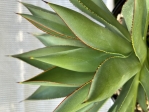
After it was pointed out in another thread what I had grown as marmorata is probably not despite the seed I grew them from being labelled as such (first pic attached is of one of the potential imposters, they do look cupreata-ish now that it was pointed out).
After going through all of my 'marmoratas' I have a single plant that might actually be marmorata, the seed for this one was from a different source to all the others.
It is only ~12 months old, so still a bit little to know, but what are your thoughts, could this be a marmorata (second picture)?
IMG_20200923_105146800_HDR~2.jpg (256.29 KiB) Viewed 4947 times
IMG_20200924_083955653_HDR~2.jpg (218.79 KiB) Viewed 4947 times
KLC wrote:Agave marmorata are often times reddish on the back sides of the leaves.
Strangely the potential imposter marmoratas were distinctly reddish especially on the underside of the leaves for the first year, however my cupreatas were also distinctly reddish when young.
I'm away for a couple of days but will check how rough the leaves are when I'm back there.
I checked the leaves, they are rough to the touch on both the top and lower side on the smaller plant (pic #2) the leaves on the plant in pic #1 are slightly textured on the underside and reasonably smooth on the top side.
Also re the reddish colour on the underside of the leaves both cupreatas and (apparent) marmoratas I've grown from seed have this reddish/purple when young.
I've attached pics of a few more, these guys are only 11-12 months old. First one is cupreata other two are meant to be marmorata, although a ? now hangs over that in my mind and only time will tell for these guys, at present their leaves do have a distinct texture.
IMG_20201002_163422916.jpg (173.77 KiB) Viewed 4783 times
IMG_20201002_163437921.jpg (146.74 KiB) Viewed 4783 times
IMG_20201002_163454518.jpg (164.98 KiB) Viewed 4783 times
Ok so lets think about this...are you sure your cupreata are really that? Unless YOU collected the seeds from an isolated plant that was properly identified, there's no guarantee agave seeds will grow up to be true to their description. I've grown maybe a hundred species from seed that I got from multiple sources over a period of several years and not all of them grew up to be as described. Just sayin'.
Those marmorata seedlings in your last post appear to be marmorata.
I sold all of my marmorata, in hindsight I should have kept at least one of them. They get very big.
KLC wrote:Ok so lets think about this...are you sure your cupreata are really that? Unless YOU collected the seeds from an isolated plant that was properly identified, there's no guarantee agave seeds will grow up to be true to their description. I've grown maybe a hundred species from seed that I got from multiple sources over a period of several years and not all of them grew up to be as described. Just sayin'.
Those marmorata seedlings in your last post appear to be marmorata.
I sold all of my marmorata, in hindsight I should have kept at least one of them. They get very big.
Yes, all I know is I planted some black agave seeds and how true or correct what is on the seed pack is completely out of my hands.
Seeing them change around the 12 month mark from generic looking 'agave seedlings' to having some character is part of the fun for me.
The more I learn about agaves the more I realise I don't know, I also don't feel too bad given HSG himself struggled at times with identification and classification of them even though he spent his entire adult life cataloguing, classifying, travelling, teaching and writing about agaves.
HSG did a damned fine job of it, don't let anyone suggest otherwise. He did make a few errors in regard to Arizona agaves, but had reached a rather advanced age by that time, so had a great deal of AZ field work done by proxy.
Agave
"American aloe plant," 1797, from Greek Agaue, proper name in mythology (mother of Pentheus), from agauos "noble," perhaps from agasthai "wonder at".
"Some talk the talk, others walk the walk, but I stalk the stalk"
Thanks for posting your marmorata picture KLC, I'm looking forward to watching my "marmoratas" this summer and seeing how they compare at the end of the season.
Re HSG, don't get me wrong AoCNA is one of my favourite books (see attached pic for reference). If it's an AZ agave, which are my most precious babies in the nursery, I refer to a certain someone's book (far right of pic), for any other agave I refer to AoCNA (check out the number of bookmarks I have in that thing), every time I read through it I am in awe, it is someone's entire life's work distilled into a book.
I have grown many other species of plant in my time and even very closely related species are normally easily and immediately identifiable to even a moderately experienced eye, agaves are another elusive and enticing beast entirely.
IMG_20200827_145320975~2.jpg (109.61 KiB) Viewed 4715 times
The plants in the top two pictures are not A. marmorata but the others in post # 6 look good for A. marmorata. The picture in post 12 by KLC shows the characteristic way that Agave marmorata leaves and others in that section unwrap from the core.
I wouldn't discount it if leaves are suitably textured, but they'll need to grow a little before confirming.
Agave
"American aloe plant," 1797, from Greek Agaue, proper name in mythology (mother of Pentheus), from agauos "noble," perhaps from agasthai "wonder at".
"Some talk the talk, others walk the walk, but I stalk the stalk"
Ok, I think I'm getting somewhere with these marmoratas
I eventually found all of these guys in my seed grown agaves.
All have the same unmistakable texture to the leaves, and don't have many leaves.
They are a bit 'extra' red now as it hasn't rained a lot here (after it raining a LOT for months) and they've gone from 70% sun to 100% sun when I planted them.
IMG_20210815_161203937.jpg (597.38 KiB) Viewed 3315 times
IMG_20210815_161219713.jpg (609.38 KiB) Viewed 3315 times
IMG_20210815_161242512.jpg (581.71 KiB) Viewed 3315 times
IMG_20210815_161253172.jpg (543.54 KiB) Viewed 3315 times
IMG_20210815_161310731.jpg (577.91 KiB) Viewed 3315 times
IMG_20210815_161328494.jpg (564.07 KiB) Viewed 3315 times
Agave
"American aloe plant," 1797, from Greek Agaue, proper name in mythology (mother of Pentheus), from agauos "noble," perhaps from agasthai "wonder at".
"Some talk the talk, others walk the walk, but I stalk the stalk"
Gee.S wrote: ↑Sun Aug 15, 2021 10:14 am
^ Now those have the right look.
Yes I'll never need help ID'ing a marmorata again thanks everyone the texture and the way the leaf unfolds is unique and unmistakable amongst any other agave I've grown.
They also surprisingly really don't mind heaps of water and lose that red/purple tinge if there is less light/more water (I've attached a pic below of what one looks like after 12 months of ridiculously wet and cloudy weather). My place gets a bit of rain on average 1100mm/43" a year but the last 12 months we've had over 2100mm/80"!!!!! Just crazy and heeeeaps of cloud cover, summer just didn't really happen here, definitely not agave weather.
Attachments
IMG_20220319_111722713.jpg (565.83 KiB) Viewed 3029 times
Nicely grown plant. Just thought I'd share my seed grown marmorata, actually came up in a batch of Guadalajarana's, it was the only one and just goes to show you never really know what you're going to get with agaves seeds. Same as yours it started off with that distinct purple hue to the underside of the leaves. I always thought it was a different plant to the Guadala seeedlings even at a young age it grew larger and faster with fewer leaves and very rough texture. A really nice plant. Any idea how big these get? How big are your plants now? Mine is still in a pot and not sure whether to put it in the ground with the space I've' got.
^ A. marmorata is a big agave, leaves at least 1 m long. And the plants flop over sideways, so they take a lot of room.
Agave
"American aloe plant," 1797, from Greek Agaue, proper name in mythology (mother of Pentheus), from agauos "noble," perhaps from agasthai "wonder at".
"Some talk the talk, others walk the walk, but I stalk the stalk"
Agave
"American aloe plant," 1797, from Greek Agaue, proper name in mythology (mother of Pentheus), from agauos "noble," perhaps from agasthai "wonder at".
"Some talk the talk, others walk the walk, but I stalk the stalk"




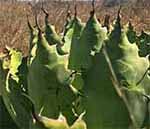
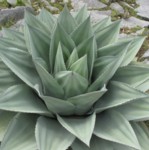

 I'll never need help ID'ing a marmorata again thanks everyone the texture and the way the leaf unfolds is unique and unmistakable amongst any other agave I've grown.